Array
(
)

When to choose MTA over free tools

(Playwright + Mendix Unit Testing)

A common question we get is: “Why shouldn’t we just use the free Mendix Unit Testing module combined with an open-source tool like Playwright, especially now that AI and MCP can help write scripts?”

If you are a small team managing only 1 or 2 simple applications, those free tools might suffice. However, our analysis shows that once your application becomes large or complex, or you scale to testing 3 or 4+ apps, MTA wins every single time.

The key drivers for a unified test solution

Relying on fragmented free tools creates a massive maintenance burden at scale. Here is why enterprise teams choose MTA to future-proof their quality assurance:
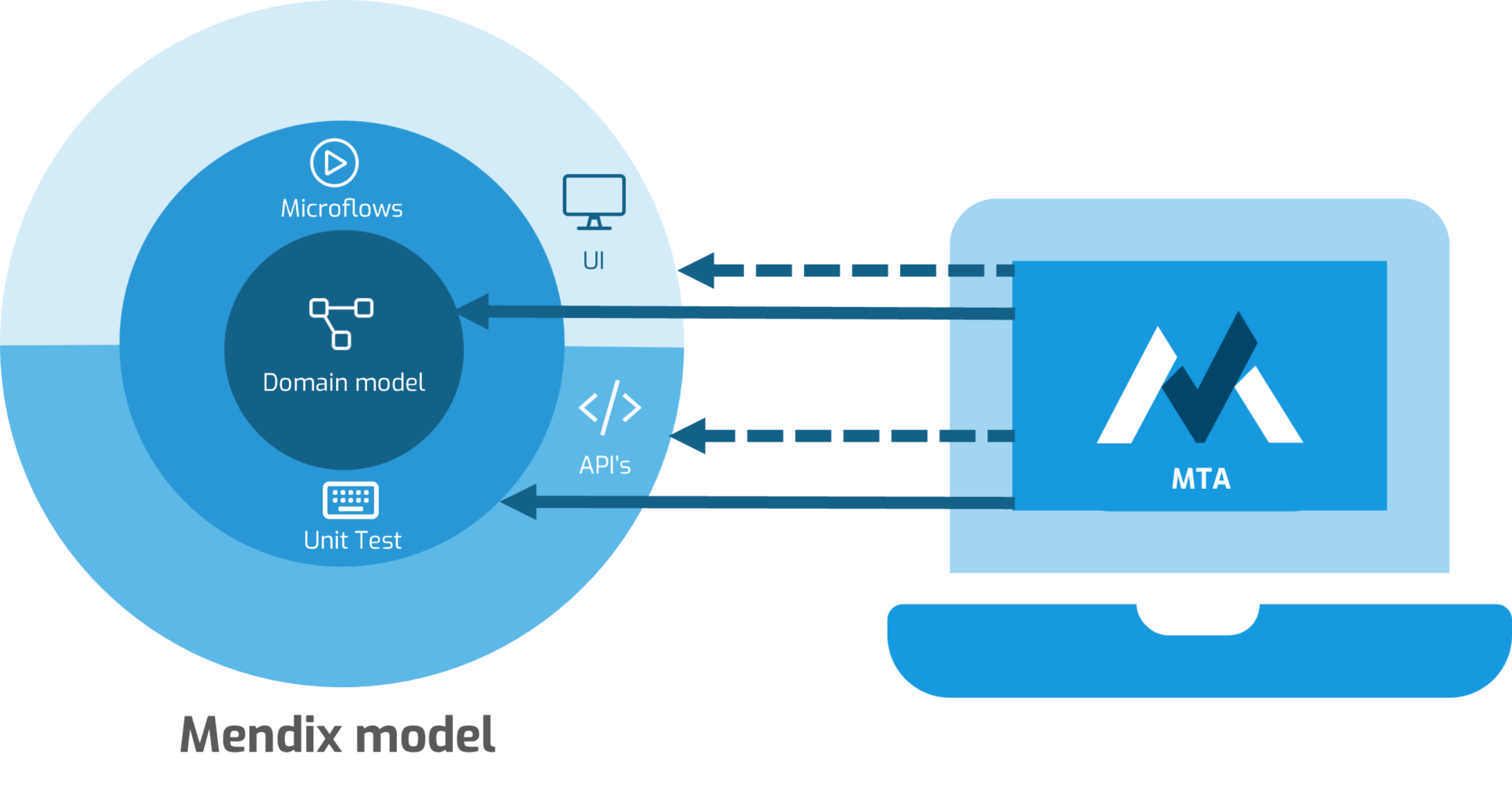
  • No-Code Simplicity vs. Scripting Overhead: MTA is a fully no-code solution tailored for the Mendix ecosystem. Playwright, even when assisted by AI, requires testers to manage, debug, and maintain complex code repositories (TypeScript/JavaScript).
  • One Unified Platform: Instead of maintaining unit tests in the Mendix module and UI tests in a separate Playwright repository, MTA keeps all your tests—from microflow unit tests to UI and end-to-end process tests—in one single tool. This saves your team countless hours in test management and execution.
  • Unmatched Maintenance Speed & Self-Healing: Because MTA is deeply integrated with the Mendix model, it is infinitely faster to maintain. MTA features automatic model evaluation and self-healing for both UI elements and backend microflows, drastically reducing the time spent fixing broken tests when your app changes.
  • Out-of-the-Box Data Management: Free tools leave you to figure out test data on your own. MTA provides built-in, out-of-the-box data management tools for the setup and teardown of test data, ensuring your databases stay clean and your tests remain deterministic.
  • Native Data-Driven Testing: MTA makes it incredibly easy to run tests with multiple datasets to test different permutations and edge cases without ever altering the core test scripts.
  • Enterprise-Grade Governance: Unlike fragmented open-source setups, MTA provides enterprise-level access control, monitoring, and dashboards. IT Managers and Product Owners get instant, secure visibility into the health of their entire application landscape.
Direct Model Testing and UI API testing with MTA

Compare MTA with other tools

In the table below we compare  MTA with other tools that are used for testing of Mendix apps
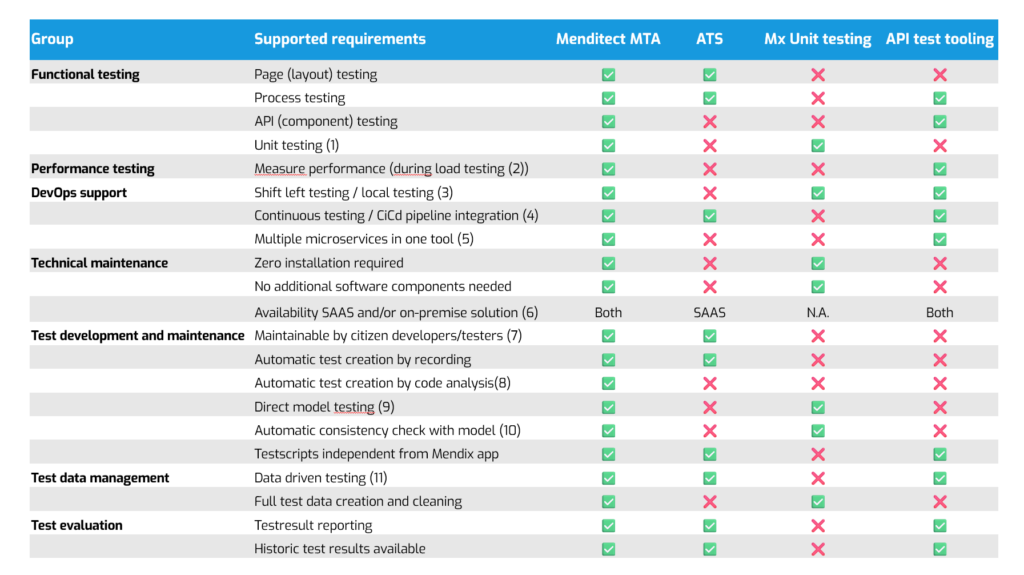
The numbered items in the table are explained below

  1. Unit testing: Test single (small) microflows to get a high test coverage without introducing a exponential number of tests
  2. Load testing: Set load on the system and measure execution time of executed (top) microflows.
  3. Shift left testing / local testing: Test the software during development. This is important because the sooner you execute tests, the sooner you discover bugs. Therefore shift left testing prevents time and money consuming repairwork afterwards. Most extreme type of shift left testing is ‘local testing’ before the software is committed.
  4. Continuous testing / CiCd pipeline integration: Test execution is part of the delivery of the software (in a CiCd pipeline). In case of defects, the delivery stops before damage is done to your production environments.
  5. Multiple microservices in one tool:  The development team can test multiple Mendix apps in one testrun. This simulates processes that interact with multiple systems.
  6. Availability SAAS and/or on-premise solution: A SAAS solution provides a hassle free test tool without the need to have knowledge about the installation of the tooling. The customer needs to setup and host the tool for an on-premise solution. However, this allow to keep all test data within the security boundaries of the own company.
  7. Maintainable by citizen developers/testers: Design and automate tests in collaboration with citizen developers and testers, without the need for test automation specialists
  8. Direct model testing: Testing the application by utilizing the Mendix model itself as a repository, instead of creating a test repository from scratch
  9. Automatic model evaluation: Test scripts are compared and evaluated with the Mendix model designtime instead of runtime. This saves time and makes debugging test results easier
  10. Data driven testing: A test runs with several datasets in order to test different situations without altering the test scripts. Data driven testen saves a considerable amount of time and money and lowers test script maintenance.

MTA vs Mendix unit test module

In the table below we compare MTA more in detail with the Mendix unit test module

Unit test comparision

dick menditect

Want to see Menditect in action?

Contact us or schedule a demo

Menu